Research Day Spotlights Students, Postdocs, Staff
The Office of Scholarship and Research Development presented Columbia Nursing’s largest Research Day to date on April 16, 2026.
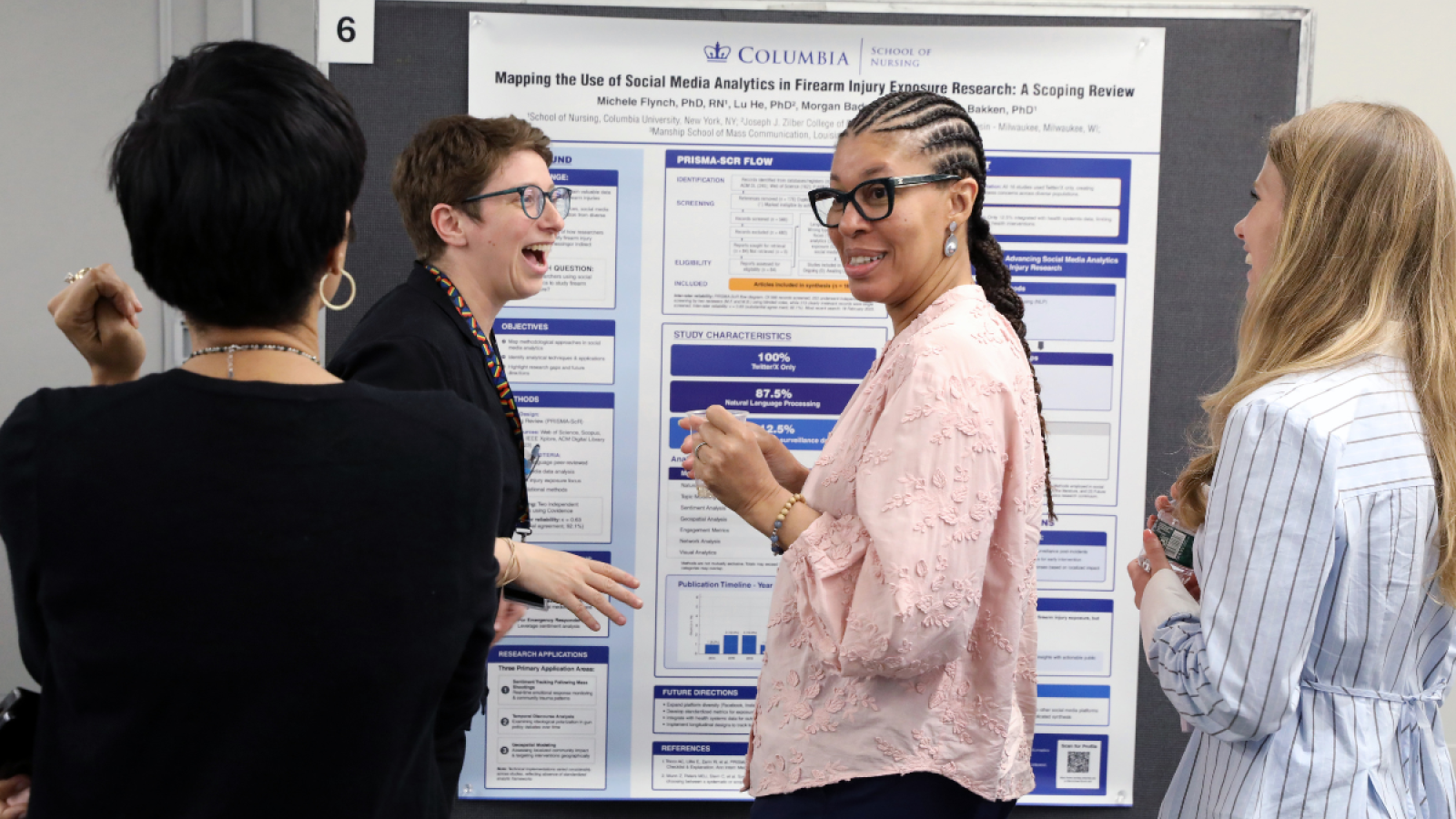
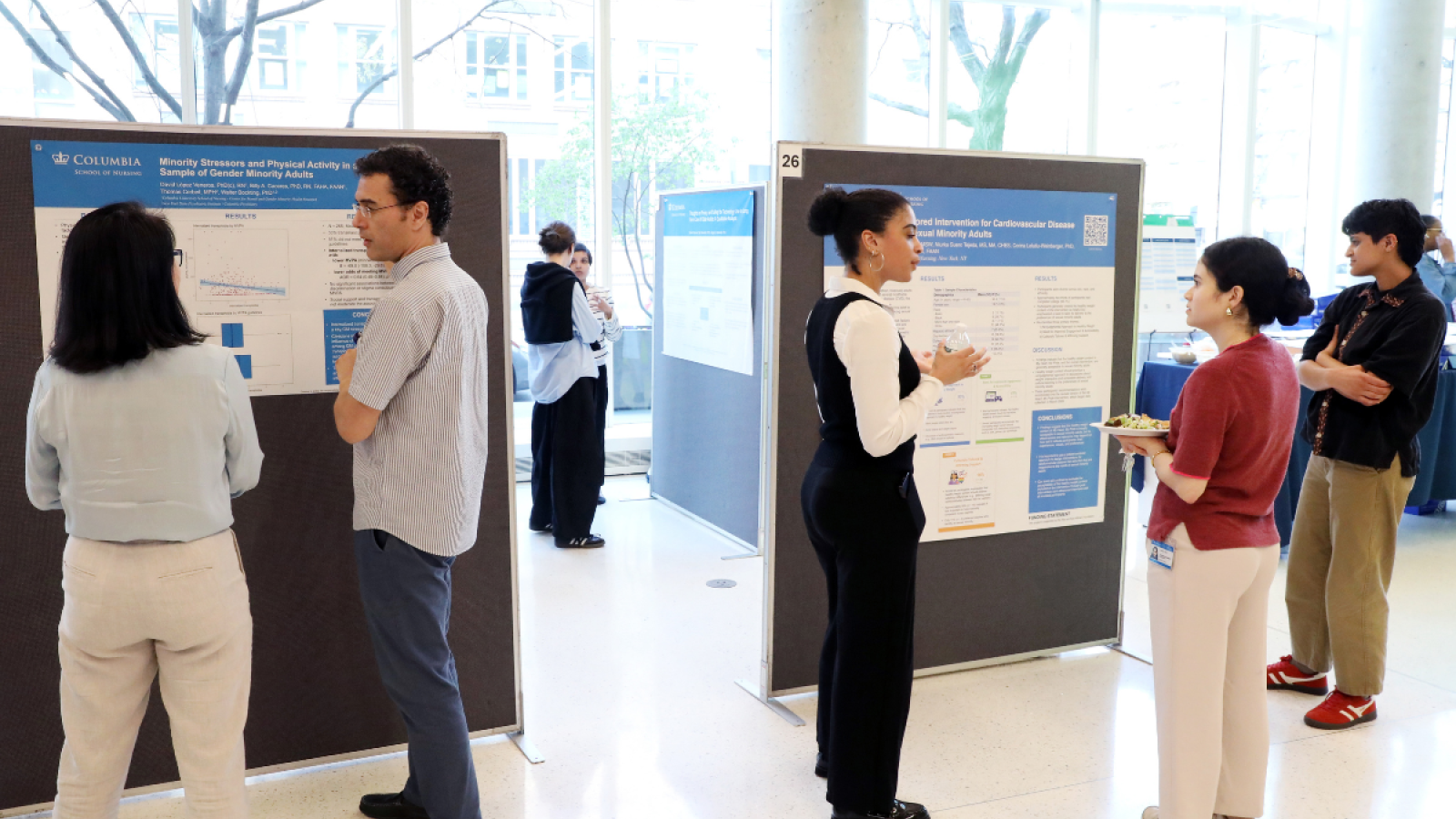
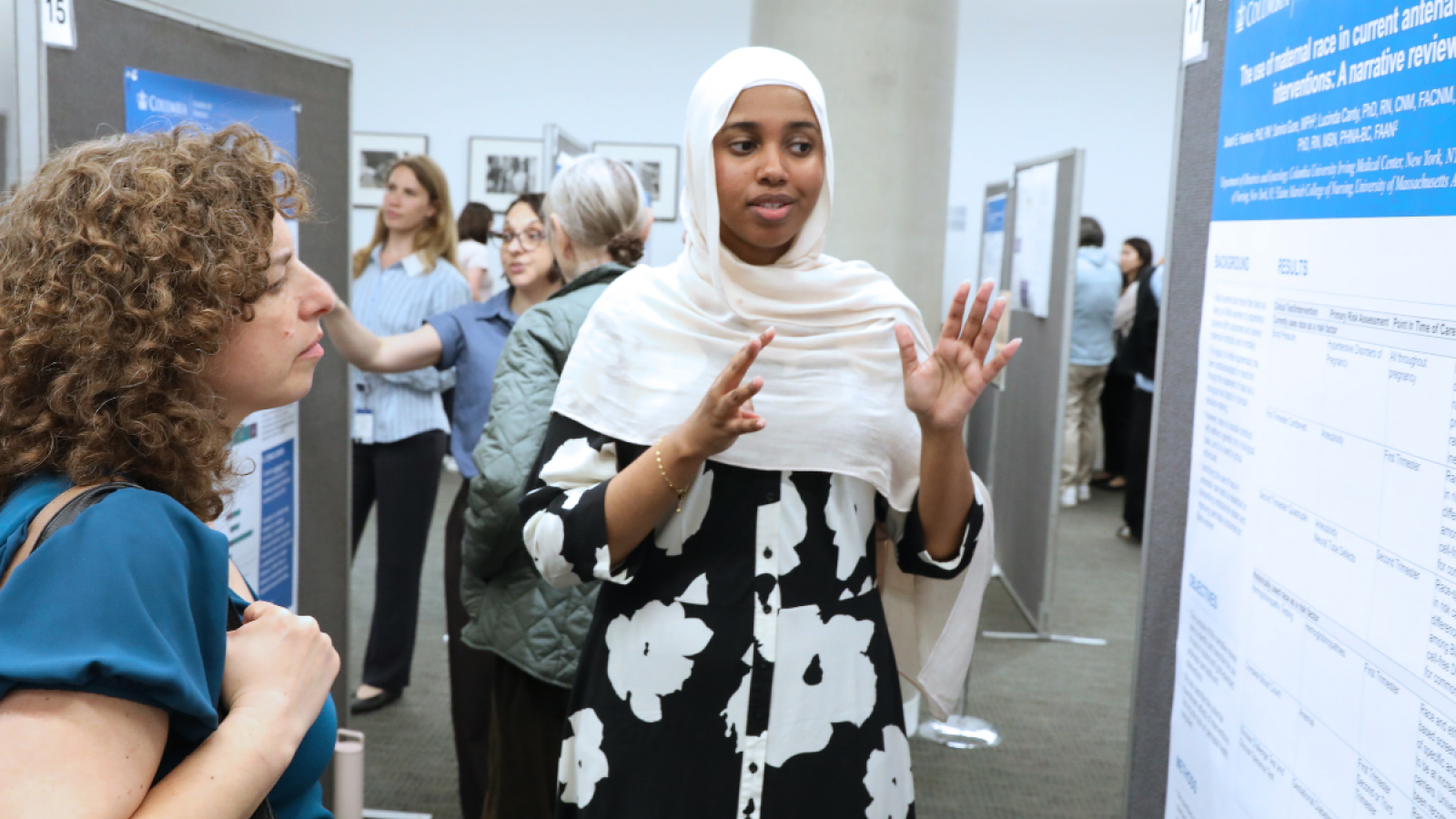
The event opened with a poster session in the first-floor lobby, with 42 posters presented by 15 PhD students, 14 postdoctoral students, 12 research staff, and one academic-practice research fellow. Presenters categorized their papers based on Columbia Nursing’s research priority areas and could choose more than one category. Topics included human-centered AI (n = 11), health and development across the lifespan (n = 20), exposomics (n = 4), and health systems science (n = 18).
Following the poster session, Professor Suzanne Bakken, PhD, moderated Research Engagement and Knowledge Translation, a panel featuring viewpoints from the directors of each of the school’s five research centers.
Leaders spoke about their center’s most important contributions to the school and to the broader community. Gregory Alexander, PhD, who became director of the Center for Health Policy in 2025, discussed Albany Day, which gives students from across Columbia University Irving Medical Center hands on experience with health policy and advocacy. Students met with legislators, staffers, and other officials, including the state health commissioner. “He had a lot of interesting insights into how our students could really make a difference and why their voice matters,” Alexander said.
Jacquelyn Taylor, PhD, founding executive director, Center for Research on People of Color, spoke about the importance of community partners in the center’s research. “We do rely on our community partners very heavily to give us feedback to guide us on how our research should be, how we reach out to our communities, how we can best serve them, and what we can give back,” Taylor said, noting that ensuring adequate compensation for their contributions is also essential.
Tonda Hughes, PhD, director of the Center for Sexual and Gender Minority Health Research, noted that Columbia Nursing hosted the first national LGBT Health Summit in 2019. The event has produced eight publications, with three more in review, nearly all with student co-authors. “That really put us on the map, I think, in terms of sexual and gender minority health,” she said. The center will celebrate its fifth year this month.
Lusine Poghosyan, PhD, executive director, Center for Healthcare Delivery Research and Innovations, described her work with Columbia Global Centers Athens to support the nursing workforce in Greece and Armenia in delivering care for displaced people. “When displacement happens, when people lose their homes and they're settled in other countries, nurses are always the first person in contact,” she noted. Poghosyan and her team are also planning a symposium on strengthening and growing the nursing workforce in Thailand, Japan, and South Korea.
Ruth Masterson Creber, PhD, executive director and research lead, Center for Community-Engaged Health Informatics and Data Science, spoke about how human-centered AI is impacting Columbia Nursing’s education, research, and partnerships across the university. “The vision in the center is really to enable and prepare our students, our nurses, to be able to use AI very meaningfully,” she explained. “That nursing lens really applies to how we’re using AI, how we’re using it responsibly, transparently, and that applies to the way that we’re using the data, the methods that we’re using, and in thinking about the application of all of our work.”
After the panel, awards were presented for the best poster in three categories, as voted by faculty judges:
PhD student Xuefan (Audrey) Ji, for Is Palliative Care Service Availability in Primary Care Associated with End-of-Life Hospitalization and Emergency Department Use Among Medicare Beneficiaries with Dementia?
Postdoctoral student Sarah Harkins, PhD, for Nursing Documentation Patterns During the Inpatient Labor and Birth Hospitalization.
Research coordinator Bailey Middleton, for Tailoring Healthy Weight Content in “My Heart, My Pride” to Reduce Cardiovascular Risk Among Sexual Minority Adults: A Qualitative Study.